Showing posts with label engineering. Show all posts

Saturday, December 27, 2025

Second-gen portable power station with DIY 24V lithium-ion battery

Finally all the pieces are coming together! With my DIY 24V lithium-ion battery complete, it’s time to put it all together into a new portable solar power station and retire my original one. The original power station used a lead-acid AGM battery (60lbs alone), so was not very portable. This new one is more than double the capacity, less than half the weight, and cleanly packaged.

The goal for this project is to make a battery station that is always active and collecting power from my solar panels. This means the DIY powerwall can stay dormant most of the time for maximum safety. Once the solar battery fills up, I can dump it into the powerwall all at once with a boost converter (to go from 24V to 48V), or at any time use it to charge up my ebikes (generally also with a boost converter).

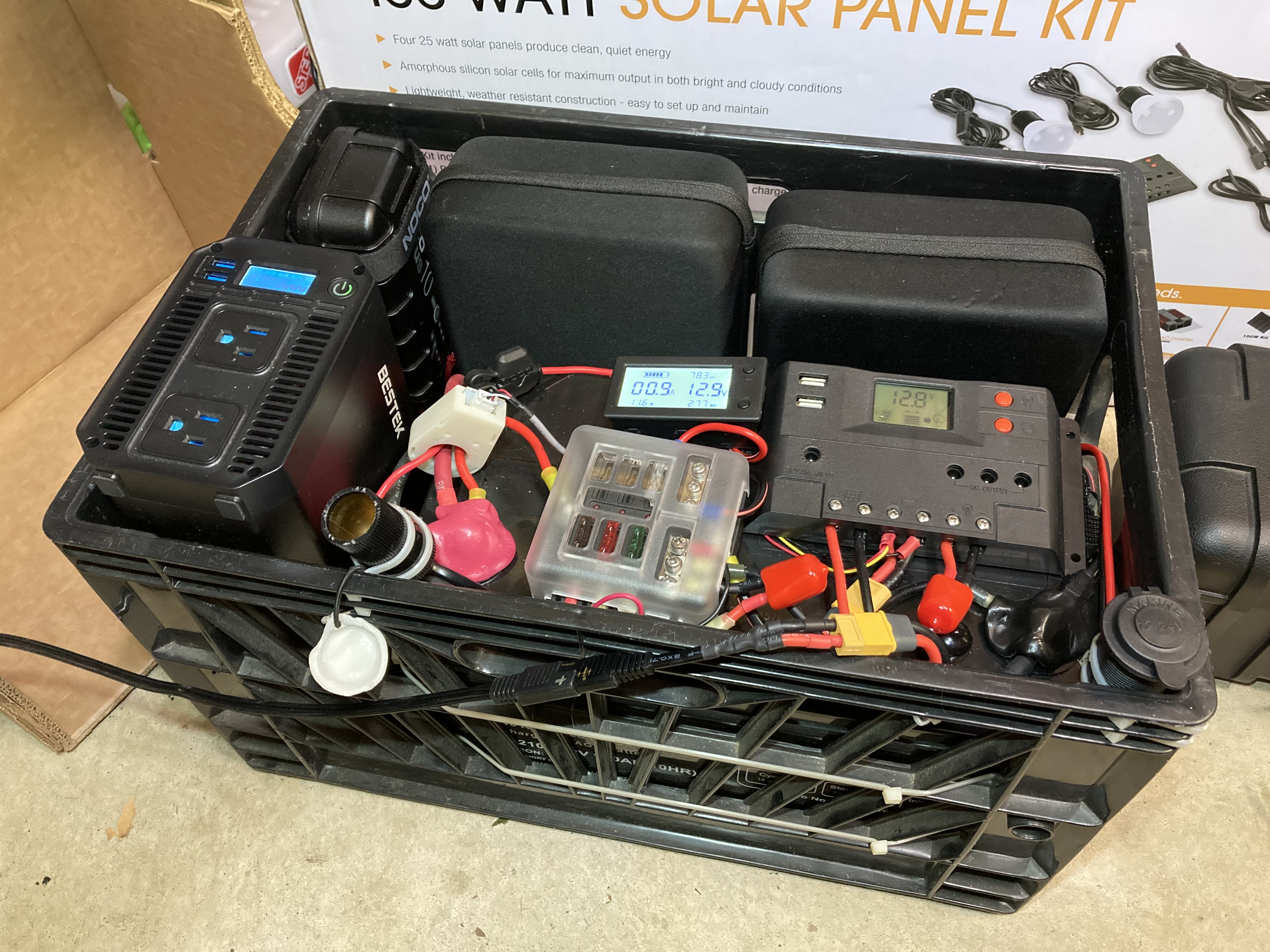
The business inside the power station
The business inside! Solar charge controller, fuse block, and power input/output ports. More details below

Tuesday, May 7, 2024

24V Lithium-Ion Battery Build for Solar Power Station

After building my first semi-portable solar power station and then DIY powerwall, I decided it was time to take my battery building to the next level. I had access to good lithium-ion cells from cancelled ebike projects, but what to make?

Design Choices

A more compact 12V system would be a natural choice, but standard nickel manganese cobalt (NMC) lithium-ion cells are not a great choice due to their voltage range (see note below). A 7S system (seven cell strings in series) works really well with 24V inverters and standard low-cost solar equipment (including charge controllers and automotive-style fuses). 7S it is!

Battery build in process
Battery build in process, showing the spot welder

Thursday, February 2, 2023

Load Sharing Between Parallel Lithium Ion Battery Packs

Now that my giant DIY powerwall has been built using parallel battery packs, the question came up about how current is shared between the different packs. Most packs are the same, but the second style of packs has a different capacity, different 18650 cell model, and different number of cells in parallel. What does this mean for current sharing between these packs as they discharge? Let’s find out!

Going into this, I suspected that the current flow from each pack would be proportional to its capacity, because if a pack is rated at X number of amp-hours, that current all needs to be delivered over the course of discharge. While in the end this was correct on average, what I did not expect was the amount of variation within the discharge curve.

To find out how the current is shared between the packs, I took one of each type (13s5p/15.4Ah and 13s4p/12.5Ah), charged them up fully, and put them in parallel. Using a DC load to discharge tells me very accurately the total current coming out of the packs, and a current meter in line with one of them lets me know the fraction coming from each pack. (The two packs must combine to total the current being drawn by the DC load).

Test setup

First, confirming that the current measurements are accurate—they are.

Showing 4A flowing from the power supply (top) to the DC load (middle). Fluke meter (bottom) is in-line and agrees. Clamp meters (right) are always a little off; this one is decent.

Wednesday, January 18, 2023

How to build a DIY powerwall using parallel ebike batteries

After building my first portable power station, I kept going deeper into understanding how battery, solar, and inverter systems work. Combined with access to a whole pile of barely used (yet on their way to recycling) ebike batteries, I decided to give them a second life and build a DIY powerwall out of them. The term comes from the Tesla Powerwall which is a wall-mounted battery designed to provide backup power to a whole home. What can we make ourselves?

Completed 48V parallel battery system showing 16 installed packs (of 20), charging at 18.6A

Saturday, January 7, 2023

What's the difference between Ikea Bror shelving and workbenches?

It was time to reorganize my garage to make room for a new running treadmill, and the Ikea “Bror” line of shelving, drawers, workbenches, and storage solutions caught my eye. But from the website descriptions it was really hard to see just how sturdy certain items were, and why the workbench-style units cost so much more than the shelving. This is what I learned! I reviewed the Bror here because I couldn’t find any reviews that covered this type of info.

Fully assembled, expertly modeled, but poorly organized Bror storage system

Tuesday, May 17, 2022

How to get the most power out of the MPT-7210A boost charger

In normal solar power systems used to charge batteries, the solar panel voltage is higher than the battery voltage, and a traditional charge controller can then be used. Sometimes, you want to charge a battery that has a higher voltage than your panels, though, such as an ebike battery with a small solar panel. For that you need a boost charge controller or boost converter. Very few are available, and the most common seems to be the MPT-7210A "MPPT" charge controller. It can also be used to turn any DC power supply (even a free cast-off laptop charger) into a battery charger.

MPT-7210 boost charge controller
The MPT-7210 boost charge controller

I say MPPT in quotes because the MPT-7210A does not actually do Maximum Power Point Tracking. But it is still a valuable tool -- it is basically a programmable boost converter that has a setting for the minimum input voltage to use. That way, as it ramps up power and the voltage of your solar panels is pulled down, it does not just keep increasing current and collapse the input voltage to zero like a normal boost converter would do, but instead stops when the voltage is pulled down to your setpoint. See my previous post on DIY power stations for more discussion on how MPPT technology works.

Sunday, April 17, 2022

DIY portable solar generator power station

So that we could improve general preparedness and be more comfortable during power outages, I decided it was time to buy or potentially put together a portable power station like is so popular for camping/outdoors and emergencies these days (such as from Jackery or Goal Zero; see portable power stations at REI). They are also awkwardly called "solar generators" because they can be charged with solar panels, even though they are really just batteries with some outputs. I suppose the solar panel is the true generator.

I realized this was actually a perfect opportunity for DIY: commercial systems are quite expensive, and DIY would be achievable since the components are so modular. Can be as simple as battery, inverter, and charger. Let's do it!

Completed solar generator power station in a milk crate
Completed solar generator power station in a milk crate. Battery, charge controller, inverter, charger, 12V outputs, USB ports, and zippered pouches for cables and accessories

Wednesday, May 12, 2021

Fixing a broken solar-powered motion light

I love the solar-powered motion lights I have at my house but recently one started coming on during the daytime, then by night barely had any battery left, so something was definitely not working right.

Success! Battery-powered light now running from a wall USB charger

For fun I decided to open it up with my daughter to explore, and found that to my surprise, the inside was delightfully modular! Ripe for hacking. Maybe other models are similar inside? Let me know in the comments, please. I used the MITAOHOH MT-SL-82-4P which comes in a 4-pack for a shockingly low $20-$25.

(In general, it still blows my mind that any company can put products like this together for so cheap -- LEDs, solar panels, batteries, connectors, screws, wires, motion sensor, circuit board, and injection molded housings for $5 each, shipped to my door. Wild. That means negative externalities, unfortunately.)

Sad, dim solar light on during the daytime where it can't help anyone

Saturday, July 18, 2020

How to Carry a Bike With Another Bike

For years I’ve wanted to tow a bike with another bicycle and had this towing solution tucked away in my garage. Now I finally want to make it available to everyone! What do you do when you have one person and need to move two bikes? Maybe you’re taking a bike to be repaired, or your dirt jumper to the bike park, or picking up your friend at the train station and don’t want to drive there. Or you left your bike at the bar and need to pick it up the next morning. I searched all over and couldn’t find a solution that was compact, easy, and did not involve disassembling the second bike, so I designed my own device to tow one bike behind another.

Updated 6/17/2023

Attached bike ready to tow, thanks to my assistant


Assembled bike towing system ready to ride
Ready to go! And it won't fall over!

Wednesday, May 29, 2019

Engineering's Unwritten Rules

When I was at a large company managing diesel engine testing and development, my director passed along the following document he called "Engineering's Unwritten Rules". It really resonated with me because it solidified so many thoughts I had had for years.

I suspect many engineers have a similar story of documents like this being passed down through the (workforce) generations, because through some googling I found out that this was actually someone's summary of a series of three articles from 1944 by W. J. King, originally published in Mechanical Engineering magazine as "The Unwritten Laws of Engineering". (The full document has since been made available for purchase via ASME and includes some modern updates. A scanned older version is also available on Google Books.)

The Unwritten Rules of Engineering

Regardless, what I received years ago was a nice document on its own, though was surely modified by a few people over the decades. It focuses on the first portion of the original article series, on the successful behaviors of new engineers. It is presented here with minimal modification [with additions by Mike in brackets]:

Monday, November 26, 2018

Book Review—Thinking in Bets by Annie Duke

Thinking in Bets (Making Smarter Decisions When You Don't Have All the Facts) has been a wildly popular book, and I can see why. I was really excited about the prospects—who isn’t interested in better decision making? And as an engineer, finding that balance between gathering enough info and taking action is a key career skill we can all improve. Did this book deliver? Partly.

Wednesday, November 7, 2018

Soto Pocket Torch Troubleshooting for No Flame or Weak Flame

If your Soto Pocket Torch has stopped working, or the flame is small or weak, this guide can probably help you fix it -- it's likely not broken! The Soto PT-14SB torch is a great tool for camping, backpacking, and around the house for lighting candles and sealing rope ends. It uses disposable lighters instead of a fuel reservoir, so there is no fussing with refills and more fuel is always available at the local convenience store. I’ve seen two problems occur over the years: small/weak flames, and no flame at all.
A good flame!

Monday, January 1, 2018

Book Review—Eat That Frog! by Brian Tracy

Eat That Frog! is a pithy business success book that is effective and short. Basic premise: begin each day with the most important and difficult task that will have the greatest impact on your job and life. After that, everything will seem easy in comparison.

"It has been said that if the first thing you do each morning is to eat a live frog, you can go through the day with the satisfaction of knowing that that is probably the worst thing that is going to happen to you all day long.

Your “frog” is your biggest, most important task, the one you are most likely to procrastinate on if you don’t do something about it. It is also the one task that can have the greatest positive impact on your life and results at the moment."


Thursday, December 29, 2016

Make an Old-school two-way pager with Arduino

I made a 2-way pager with an Arduino, GSM shield, and LCD shield. I’ve found this idea to be more useful than at first glance—I designed it so it could be used by children in lieu of a real cell phone, or it could be used as an “SOS” button for someone working alone outdoors or even exercising (if it was a bit smaller). And for the last few weeks, this device has been always on in my living room where my wife and I leave silly messages for each other.

Summary: This project sends and receives text (SMS) messages via an arduino with cellular modem built into a small enclosure with an LCD display and simple control buttons. Full details of the design and build are on Hackster.io.

Could also be called "Most expensive pager made in 2016 ever."

Update: People seem to like this project! It has over 10,000 views, and was even featured on Hackster’s Handpicked Projects of the Week.


Friday, November 18, 2016

How to make a cellular-connected garden monitor

Check out this project I made to monitor the soil moisture level of my remote garden plot. Since the garden has no power or internet available, it uses a cellular data connection to send info back to a cloud service, and then that data gets passed to another cloud service for plotting. A great learning experience!

I posted all the details on Hackster.io, a community for hardware makers with lots of interesting projects:


Thursday, June 16, 2016

Book Review—The Lean Startup by Eric Ries

The Lean Startup is an influential business book by Eric Ries that seemed to really make waves through the software industry and beyond. The premise, reduced to just one sentence: build a “minimum viable product” to get early feedback from customers to avoid the risk of a long development process that results in a polished product that no one actually wants. Being somewhat familiar with the concepts of lean manufacturing, I thought I would see if some of the ideas could be applied to physical product development.

The Lean Startup by Eric Ries

Friday, April 15, 2016

Book Review—Zero to One by Peter Thiel

In Zero to One, author Peter Thiel makes the case for unorthodox thinking in order to build the future purposefully by creating companies so good they can effectively reap the benefits of a monopoly for a long period of time, potentially decades. He argues that the path to making money long-term is to make a product at least 10x better than the so-called competition and not get trapped in the traditional thinking of making incremental advances on existing products. The all-electric Tesla Roadster, for example, was in a league of its own when it launched and created much better opportunities for Tesla than if they had made something to compete with the Honda Civic.

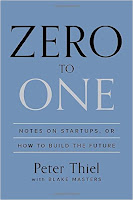
Zero to One by Peter Thiel

Wednesday, March 2, 2016

How to make a vertical laptop stand from laser-cut acrylic

When my wife is working from home, she likes to sit at a proper desk with a monitor, keyboard, and mouse instead of hunching over her laptop. To make it easy, I set up an "umbilical cord" of power, USB, and display connection to plug in and off she goes. To free up room on her desk she lays her 13" Macbook Air on the floor which is always kind of awkward. To resolve this, I thought a space-saving vertical laptop stand could help, much like one of these made by Twelve South or Rain Design.

But it's no fun to buy one; let's design and build one from scratch out of laser-cut acrylic!

The two copies of the laptop stand I cut out of acrylic

Sunday, February 21, 2016

Mini Book Review—Making Things Move by Dustyn Roberts

Making Things Move by Dustyn Roberts is well described by its subtitle "DIY Mechanisms for Inventors, Hobbyists, and Artists". I picked it up at the library to see if there were any fun new pieces or tricks I could learn from as an engineer. Highlights included the parts about the internal workings of stepper motors and a trick on how to drill a hole in the center of a shaft without a lathe. So while there were some cool new tidbits, it was mostly just fun to see all these topics in one place and easily approachable for new people.


Notable covered topics:

  • The six simple machines
  • Material types, properties, and tolerances
  • Fastening and joining
  • Forces, torque, power, work, energy sources
  • Intro to hobby motors and servos and their control
  • Bearings, gears, screws, springs, cams, linkages, and motion conversion
  • Lots of example projects bringing these concepts together
For a non-engineer getting into making projects with electronics or motors, this would be a great resource I would recommend. If you are already an engineer with some making experience, this book would be just for fun.

Saturday, November 21, 2015

Book Review—The Design of Everyday Things by Don Norman

The Design of Everyday Things by Don Norman was my first foray into studying industrial design, rather than the mechanical design techniques I am accustomed to. The number of complimentary concepts and issues definitely makes this book useful for engineers. It was updated with modern examples in 2013 after 25 years of success, and incorporates topics from many of the author's separate books and articles.

Book cover of The Design of Everyday Things


A Note on Affiliate Links

Please note that my site contains some affiliate links where I will earn a commission if you purchase the linked product. In 100% of the cases, these are for products/sites I have tried and/or own, or for books I have read. I do it for the learning experience and just for fun!